The Tragic Case Of Joan O Rourke

 Spotify
 Apple Podcasts
 RSS Feed
 Castro
 iHeartRadio
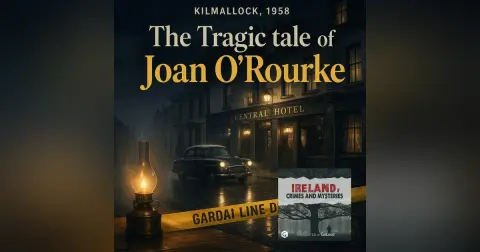
 The Joan O Rourke case is one of the most tragic stories in Irish true crime. On the morning of 29th December 1958, a priest was called to the Central Hotel in Kilmallock, County Limerick, after being summoned by a 15 year old boy. Inside, his mother lay in the kitchen, gravely injured a discovery that would lead to one of Ireland’s most disturbing cases.
Joan O’Rourke was 40 years old. She was a businesswoman, a mother of three, and a well known figure in her local community. She ran one of the busiest hotels in the town.
But what was happening inside the Central Hotel was not hidden. Staff, neighbours, and people in the town had seen and heard enough over the years to know that life behind those doors was far from stable.
In this episode, I take you through the final days and final hours of Joan’s life, the evidence given by dozens of witnesses, and the events of that night that would leave three children without a mother.
This is a case that shocked Ireland at the time. It is also a case that raises difficult questions about what was seen, what was known, and what was not acted on.
What Happened in the Joan O Rourke Case?
The events surrounding the Joan O Rourke case shocked the local community and left lasting questions that still resonate today. As details emerged, investigators worked to piece together what had happened in the hours leading up to the discovery.
This case stands out not only for its tragic nature but also for the unanswered questions that followed. Like many historical Irish crime cases, it highlights the limitations of investigative techniques at the time and the challenges faced by authorities.
Why This Case Still Matters
The Joan O Rourke case continues to be remembered as a significant moment in Irish true crime history. It reflects both the human tragedy involved and the evolving nature of criminal investigations.
By revisiting cases like this, we gain a deeper understanding of how justice systems have changed and why these stories still capture public attention decades later.
This episode contains discussion of domestic violence.
If you or someone you know is experiencing domestic violence:
-
Ireland: Women's Aid 1800 341 900
-
Northern Ireland: Domestic & Sexual Abuse Helpline 0808 802 3347
-
Men's Support: AMEN 046 902 3718 (ROI) / 028 9024 1929 (NI)
Head over to the Ireland Crimes and Mysteries website for more !
- Sign up for your €1 a month Shopify Trial at Shopify.ie
-
www.irelandcrimesandmysteries.ie
Join me over on Patreon for extra perks
https://www.patreon.com/IrelandCrimesandMysteries
Early access to episodes, monthly livestreams where we will be discussing the cases I've covered and much more as we build our own community.
Follow on Instagram:
https://www.instagram.com/irelandcrimesandmysteries/
Follow on TikTok:
https://www.tiktok.com/@irelandcrimesandmysteries
Follow on Facebook:
https://www.facebook.com/irelandcrimesandmysteries/
Follow on Threads:
https://www.threads.net/@irelandcrimesandmysteries
Follow on X:
https://twitter.com/IrelandCrimes
Visit my shop for exclusive Ireland Crimes and Mysteries merchandise
https://ireland-crimes-and-mysterie-shop.fourthwall.com/en-eur/
Support the Podcast on Patreon
https://www.patreon.com/IrelandCrimesandMysteries
Follow Ireland Crimes and Mysteries on
Instagram : https://www.instagram.com/irelandcrimesandmysteries
TikTok:
tiktok.com/@nuleseire
Facebook:
https://www.facebook.com/irelandcrimesandmysteries
Nules (0:00): Hey, guys, and welcome to another episode of Ireland Crimes and Mysteries. I want to thank you for joining me today. And if you're a returning listener, I want to say a big thank you for your continued support. If this is your first time listening to my podcast, welcome. It's great to have you on board.
Nules (0:16): So without further ado, let's get started on today's story.
Unknown Speaker (0:22): This episode of Ireland Crimes and Mysteries is supported by Shopify. Starting a business usually begins with one simple idea and a lot of excitement. But then very quickly it turns into a mountain of what ifs. What if I cannot build a professional website? What if I do not know the first thing about marketing?
Nules (0:40): What if I just cannot do it all myself? This is exactly why Shopify exists. They have built the platform so you do not have to be an expert in everything to be a success. Shopify is the commerce platform behind millions of businesses around the world, helping turn big ideas into real life brands. If you're worried about design, Shopify's ready to go templates make it easy to build a beautiful online store.
Nules (1:03): If you need a hand, their AI tools can help write product descriptions, enhance images and even generate discounts. And if people haven't heard about your brand yet, Shopify make it simple to run email and social campaigns to reach new customers. Plus their award winning 247 support is always there if you get stuck. So stop asking what if and start asking why not. Turn your dreams into and give them the best shot at success with Shopify.
Nules (1:30): Sign up for your €1 per month trial at shopify.ie. That's shopify.ie and see what you can build with Shopify by your side. Ireland Crimes and Mysteries is presented by Go Loud, Ireland's leading audio publisher and the home of Irish podcasts. Find new episodes on the podcast first on the Go Loud app and on your favorite podcast platform. On the morning of the 12/29/1958, a priest arrived at the Central Hotel in Kilmallock County Limerick to administer the last sacraments.
Nules (2:07): He had been called by a 15 year old boy. The boy's name was Jimmy. The woman he was called to was Jimmy's mother. Joan O'Rourke was 40 years old. She was found in the kitchen of her own hotel, the business she had run, the home where she had raised her three children.
Nules (2:27): She had multiple injuries. She'd been dead for some time. Her husband was asleep upstairs with the bed clothes pulled over his head. This week on Ireland Crimes and Mysteries, I'm telling the story of Joan O'Rourke, a woman who ran one of the most prominent businesses in a South Limerick market town. A woman who is known to her neighbors, her customers, her staff.
Nules (2:52): A woman whose death was front page news across Ireland in 1959 and whose story I think deserves to be still heard. To understand what happened in Kilmalloc in December 1958, you have to start not in Kilmalloc at all. You have to start in Killarney. Joan Healy was a Killarney woman. Born around 1918, she grew up in Kerry in one of the most beautiful corners of the country.
Nules (3:20): We don't know a great deal about her early life. The newspapers of the time didn't think that was a story worth telling. But we know she was in Killarney when the war years came. The years Ireland called the emergency, and that's where her life changed direction. Thomas Tobin O'Rourke was a Limerick man, born in January 1899.
Nules (3:44): By the time Joan was growing up in Killarney, Thomas already had a whole life behind him. As a young man in his late teens and early twenties, he'd been part of the most turbulent years in modern Irish history. He had joined the Irish Volunteers in 1916, left Presentation College in Limerick following what his pension records describe as a row over politics. He had gone to England briefly in 1917 and came back the following year to rejoin the fight. He was active with the East Limerick Brigade during the War of Independence, active in a real sense.
Nules (4:23): The military service pensions archive records show he took part in the attack on the RIC barracks in Kilmalloc in May 1920, one of the most significant actions of the war in that area. He was a member of the active service unit, what was commonly called the flying column. He claimed in his pension application to have shot a sergeant Maguire on a city street in Limerick in 1921. When the civil war came, Thomas sided with the free state. He enlisted in the national forces at Bruff in July 1922 and served as the second lieutenant until he resigned in July 1924.
Nules (5:03): For his combined service with the IRA and the National Army he was awarded six years service for pension purposes, which equated to an annual pension of £60 He received a supplementary grant of £125 on demobilization. Then he re entered the Defence Forces during the emergency in July 1940 and that's what brought him to Kerry. The records show he was stationed in County Kerry during that period. That's where he met Joan Healy. They married on the 03/09/1943 in Killarney.
Nules (5:40): Thomas was 44 years old. Joan was around 25. He was nearly 20 her senior, a decorated revolutionary veteran, a former army soldier, a man with a name and a history and a pension. She was a young Killarney woman beginning her married life. After the war years, the couple moved to Kilmallock.
Nules (6:02): They occupied and ran the Central Hotel, a prominent establishment at the corner of Lord Edward Street and Emmett Street, right in the heart of the town. In a small Irish market town in the nineteen fifties, the local hotel was more than just a business. It was where deals were done after the mart, where people gathered after funerals, where the town's social life played out across the bar and the tap room and the kitchen. To run it was to be somebody of standing in that community. The couple had three children.
Nules (6:35): Jimmy, born in the mid nineteen forties, was 15 by December 1958. Ita was 10, and Marie, the youngest, was just four years old. Thomas O'Rourke was known around the town as Tobin O'Rourke, a familiar face, a veteran, a local figure. But behind the door of the central hotel, something else entirely was happening. Over eleven days of depositions at Kilmallop Court before district justice Buckley, 50 witnesses gave evidence.
Nules (7:10): 50. That is an extraordinary number for a case like this, and it tells you something important. This was not a secret. What was happening inside the central hotel was not hidden from the people of Kilmalloc. It was known.
Nules (7:25): It was witnessed. It was heard. And it was for years understood as a domestic matter. Let me tell you what those witnesses described. Eileen Herbert worked as a barmaid at the Central Hotel from 1955 to the 1956.
Nules (7:42): She lived in. From her very first week there, she was disturbed during the night. She said the screaming occurred three or four times a week. After eleven at night when the customers had gone, she would hear it. On one occasion, she got up, went to the O'Rourke's bedroom door and could hear Joan screaming from inside the room.
Nules (8:04): She knocked. No response. Then she picked up a shoe and kept beating the door with it until Joan finally opened it. Joan was crying. She was frightened.
Nules (8:14): She told Aileen, the man is definitely mad. He went to choke me. Aileen brought her upstairs and stayed with her until morning. Around Ash Wednesday nineteen fifty six, Aileen was in bed when she heard a swishing noise in the corridor outside her room at around four or five in the morning. The door was pushed open.
Nules (8:36): Thomas O'Rourke was standing there in his stockings wearing trousers and a shirt with a sword in his hand. He asked for his wife. Eileen told him his wife was not in her room, so he went away looking into all the other rooms along the corridor. Maureen Power worked at the hotel in the autumn and early 1958 closer to the end. She brought tea up to the O'Rourke's bedroom one morning and found Joan was not there.
Nules (9:05): Joan was in her children's room. When Maureen went back later to check on her, Joan was holding a lump of hair in her hand. It had been pulled from the roots. The bare red spots on her scalp, Maureen said, were tender and looked as if the hair had been pulled out by force. On another occasion, Maureen was in the kitchen when Joan was carving meat.
Nules (9:28): Thomas came in to wash his hands. Having washed them, he struck Joan on the head with his fist. He accused her of being drunk. Neither of them had drink taken. Maureen Power heard Thomas say he would kill his wife.
Nules (9:44): Mary Carol, who also worked at the hotel, gave some of the most striking evidence of all. She described a night when she came to the kitchen and found Thomas with his hands on Joan's throat and striking her. He was calling her names repeatedly. Mary pulled him away. Both of them had drink taken, she said.
Nules (10:04): Joan was bruised but not bleeding. Thomas then went and came back with a chair and went to hit her with it. This continued for a couple of hours. Eventually, Joan came into Mary's room and said, that man is mad. Maurice Heelan ran Cleary's hotel in Gilmaloc just along the street.
Nules (10:23): He was awakened one morning between four and 05:00 by loud knocking at his front door. When he opened it, Thomas O'Rourke was standing outside with a sword in his hand pointing it directly at him shouting, my wife is in that house. Heelan wrenched the sword from him, told him, your wife is not in this house and you are a lunatic. Warwick was frothing at the mouth. Heelan allowed him to search the rooms to satisfy him.
Nules (10:49): When Heelan was putting him out, Thomas said, are you going to clock me? You wouldn't do it twenty years ago. Heelan said he wouldn't do it now, but would have twenty years ago. About a quarter of an hour after that incident, Thomas came back to Healing's and apologized. He said he wanted to get the door repaired and send on the bill.
Nules (11:10): Then Joan herself appeared at Healing's. It was only the second occasion she had ever been in his house. She sat down beside Thomas and said to him, Tobin, I was looking for you. Wouldn't you try and live peacefully together? Don't you know that the town and country are talking about you?
Nules (11:28): Thomas said, she has my business destroyed, Morris. Joan replied, no. But you have ours, Tobin. They left together shortly after that. Heelan noted that on that occasion, of them were perfectly sober.
Nules (11:48): Michael Mead, a farmer and shopkeeper who had known the O'Rourke's for years, gave evidence that within the previous twelve months, he had heard bickering between them. He'd seen Joan with a black eye on two occasions and black bruises on her arms and legs on several occasions. He always left when disputes would start. At Christmas, in his presence in the tap room, Joan had looked at Thomas and said, Tobin, I am black and blue after you. You will pay for this.
Nules (12:17): Thomas said nothing. Anna O'Rourke, who was a wife of a stepbrother of Thomas', lived only 200 yards from the hotel. She said Joan would arrive at her door on about four or five occasions each year, always around one in the morning, always upset and distressed. She was never drunk on arrival. Sometimes she would have some drink taken.
Nules (12:41): Thomas would call not long after with a considerable amount of drink on him and ask was Joan there. On one of those nights, Joan had not stayed. Thomas had called and told her to get up and come home. Joan got up, dressed, and came out to the kitchen where she had a conversation with Thomas in Anna's presence. He abused her about drinking.
Nules (13:03): Joan said nothing. Anna tried to settle things between them. The only remark she could recall from Joan that night walking out the door, she said he wouldn't have luck. And there was the night in April or May 1958. Three men, Michael Hurley, James Pittman and Jimmy Savage were walking along Lord Edward Street on their way home late at night.
Nules (13:24): As they passed the hotel, Hurley could see through the Ground Floor window a man and a woman. The woman appeared to be bowed down. The man was above her. She was crying. When they got closer, the man came out and walked away up Emmett Street.
Nules (13:40): Joan came out. Jimmy Savage gave evidence that he saw missus O'Rourke come from the hall door of the hotel and run towards them. As a result of what she told them, Michael Hurley struck Thomas O'Rourke on the jaw and knocked him down. As Thomas was going down the street, he said he would murder her, are words to that effect. Hurley told him he had better stop.
Nules (14:02): I struck him, Hurley said in court later, because I thought he was going to go after the woman again. James Pittman brought Joan to his house that night. She was wearing her indoor clothes. Doctor D. P.
Nules (14:15): Kennedy, senior surgeon at Limerick Regional Hospital, gave evidence that he had examined Joan O'Rourke on the 01/15/1958. She had a dislocation of the left shoulder joint. She was discharged the next day. This is what was happening year after year behind the door of the central hotel, in the corridors, in the kitchen, in the bedroom, out on the street in front of witnesses who could see perfectly well what was going on. 50 people who had seen something, heard something, known something, and Joan kept going back because there was nowhere else to go, because the hotel was the business and the business was the family and the family was everything.
Nules (14:57): And, of course, this was nineteen fifties Ireland, and this was what you just did. Bridget O'Regan was working at the Central Hotel for seven weeks as a domestic when the Christmas of nineteen fifty eight came around. On the morning of Sunday, December 28, she arrived at the hotel and brought tea up to the bedroom. Thomas was alone in the room. That was the first time she'd not seen Joan there when she arrived with the morning tea.
Nules (15:26): Joan was in the children's room with Ita and Marie and Jimmy. Bridget then went to Mass. When she came back, she went up to get Ita ready. Joan was still in the bed. Her body was black and blue on the right side from the hip down.
Nules (15:42): The bridge of her nose and the back of her left hand were also black. She'd been beaten the night before, the Saturday night, while the children slept. She got up at around half past two in the afternoon. Bridget helped her dress because Joan's hand and leg were stiff. She helped her downstairs to the kitchen where Joan set at the fire.
Nules (16:04): She didn't eat that day. After about a half an hour, she went back up to bed. Bridget had to help her up the stairs. At around five, Joan came down again. At half past six, Thomas came in from the bar for his tea with the children.
Nules (16:19): Joan set at the fire. During the half hour, they were all in the kitchen together. There was no conversation between them, not a word. Joan later had tea with Bridget. Thomas went back to the bar.
Nules (16:32): The staff went off duty. Jimmy headed to the pitchers at around eight that evening and didn't get back until about eleven. And Joan, stiff and bruised and pale, went back to work. She served the customers that evening in the snug, the lounge, the public bar, and the tap room because that's what she did. That was her job.
Nules (16:53): It was her hotel. The bar crowd left at around eleven. The lounge at around half past twelve, the snug had been quiet since midnight, the tap room at about half one in the morning. Multiple customers that evening noticed nothing unusual about Joan beyond that she was pale. Several said she had one small drink with them.
Nules (17:16): None of them saw her drunk. Antoinette Morton, an 11 year old who had been at the hotel that afternoon to play with Ita said that Thomas and Joan had not spoken to each other in the kitchen. Joan, she said, looked as if she was sick and stiff. At around eleven that night, a group of friends arrived from Fermoy. Michael Mead, David O'Donnell, missus Maureen Lavin, and miss Maeve Campion.
Nules (17:42): They were admitted by young Jimmy O'Rourke and they went into the kitchen. Joan made punch and served it. Thomas joined them. Everyone who was there that night agreed. Joan appeared pale but otherwise alright and had no drink in her in their observation.
Nules (17:59): Thomas had drink on him before they arrived and drank steadily through that evening. Five small whiskeys according to one account. He was in good form. He could stand and talk clearly, though he was not steady on his feet. At one point, Thomas looked at Joan and said in front of the whole party, look at the drunken face of her.
Nules (18:20): Joan said nothing. Nobody else commented. Mead said later that she seemed to take it as a joke in the sense that she paid no attention to it at all. He said it was untrue. She was not drunk.
Nules (18:34): The bar crowd left at around eleven, the lounge at about half past twelve, the snug had all emptied by midnight, and the tap room at around half one in the morning. Multiple customers that evening noticed nothing unusual about Joan beyond her being pale. Several said that she had one drink with them. None of them saw her drunk. Antoinette Morton, an 11 year old who had been at the hotel that afternoon to play with Ita, said that Thomas and Joan had not spoken to each other in the kitchen at all that day.
Nules (19:06): Joan, she said, looked as if she was sick and stiff. At around eleven that night, a group of friends had arrived from Fermoy, Michael Mead, David O'Donnell, a missus Maureen Lavin and a miss Maeve Campion. They were admitted by young Jimmy O'Rourke and they went into the kitchen. Joan made punch and served it. Thomas joined them.
Nules (19:27): Joan moved between the kitchen and the bar throughout the evening keeping both going. Everyone who was there that night agreed. Joan appeared pale but otherwise alright and had no drink in her in their observation. Thomas had drank in him before they arrived and drank steadily through that evening. Five small whiskeys according to one account.
Nules (19:46): He was in good form. He could stand and talk clearly though he was not that steady on his feet. At one point, Thomas looked at Joan and said in front of the whole party, look at the drunken face on her. Joan said nothing. Nobody else commented.
Nules (20:03): Mead would later say she seemed to take it as a joke in the sense that she paid no attention to it at all. He said it was untrue. She was not drunk. At one stage, Joan came in from the bar and told Thomas he should clear the till because there was good money in it after the day's trading. Thomas ignored her.
Nules (20:20): Joan was black and blue from the night before, having spent the day barely able to move, and and she was still thinking about the business at two in the morning. Missus Lavin had left a little after midnight. The remaining three stayed for one more round and then left together. They said good night to Joan in the kitchen. She reminded Mead to bring her eggs the next day.
Nules (20:41): There was no sound from anywhere else in the hotel as they left. A short time after the party had left, Mary Campion realized that she had left without the bottle of whiskey she'd come for. She went back to the hotel and knocked. Thomas answered. While they were standing there, Joan appeared at the bar doorway.
Nules (21:00): Thomas said something to her that Campion didn't catch. Then he pushed Joan on the shoulder. Joan fell on her back on the hall floor. Campion ran. She was afraid of him.
Nules (21:11): Joan showed no signs of moving as she left. Campion said later she hadn't gone to hell because she thought she would come back the next day and they would be as friendly as ever. She'd seen this before. She thought it would just blow over. That was at about 02:00 in the morning on the 12/29/1958.
Nules (21:31): The door closed behind Maeve Campion, and whatever happened next in that kitchen happened with nobody there to see but Thomas and Joan. At twenty minutes to four in the morning, Thomas O'Rourke woke his 15 year old son, Jimmy. He told him to come downstairs that his mother was drunk and needed to be brought to bed. Jimmy went down the backstairs to the kitchen. His father had gone ahead of him.
Nules (21:57): When Jimmy reached the bottom of the stairs, his mother was sitting on the last step. Her legs stretched out across the floor, leaning back against the staircase. She was unconscious. She was making no sound. Her face was swollen and very seriously marked.
Nules (22:13): Thomas was hitting her across the face with his hand. He told Jimmy his mother was drunk. Jimmy said in court that his father had a considerable amount of drink taken, but was not so drunk that he could not walk. Jimmy tried to lift his mother. He couldn't, and he got no help from his father.
Nules (22:31): He told Thomas to stop. Thomas didn't stop. He was striking Joan across the face and pushing her in the stomach with the sole of his shoe. What followed, as described in court, was a chase around the house. Jimmy tried to draw his father away from Joan.
Nules (22:47): He led him around the house three or four times up the back stairs, down the front stairs, through the kitchen, each circuit passing Joan on the floor. At one point, Jimmy retreated to his room. Thomas lost him. He wandered the corridor. The whole building was awake by now.
Nules (23:05): Thomas Dunworth, a long term resident on the Top Floor, had been woken by Ita knocking at his door. It wasn't the first time. Nearly two years before, she had done the same thing. And that night, Donworth had gone down and managed to make peace between Thomas and Joan in their bedroom. This night was different.
Nules (23:24): Thomas came to Donworth's room. Donworth tried the same line. Whatever brawl disturbs the street, let there be peace at home. Thomas sat on the bed, shook hands with him, seemed to settle. Then he got up and went back out.
Nules (23:40): He forced the lock on the door of Michael O'Shea, a bank official who also lived in the hotel. The light was on. Thomas stood in the doorway saying, I'm looking for that son of mine. I will kill him if I get my hands on him. He was in a terrific rage, waving his hands, clenching and unclenching his fists.
Nules (23:58): O'Shea told him tomorrow is another day. Thomas eventually sat on the side of the bed and settled again slightly. He said, that son of mine has gone mad altogether and the missus is down in the kitchen drunk. I want to clear out of this place altogether. O'Shea told him to send Joan on a holiday.
Nules (24:16): Take the pledge himself. Start life afresh. Joan replied, no use. No use. Then he got up and left.
Nules (24:24): While Thomas was upstairs, Jimmy had gone back down to the kitchen. He found his mother's position had changed. She was now on the floor at the foot of the stairs, not on the step. Her dress was torn at the skirt and pulled up around her waist. There was blood on the floor beneath her.
Nules (24:42): Thomas came back to the kitchen. He was hitting Joan on the face again. Her face had been marked further since Jimmy last had seen her. Jimmy told his father he would be hanged if he killed her. He said he said it to frighten him.
Nules (24:56): I did not think he would kill her, Jimmy said in the witness box. Ita, the 10 year old, came downstairs. Thomas spoke to her. Four year old Marie came down briefly and went back up. Thomas, by this point, had no trousers, shoes, or socks on.
Nules (25:14): Jimmy tried again. He went up, came back down, went into the kitchen, and pretended to his father that Joan was already dead, hoping that would stop him. Thomas told him to feel for her pulse. Jimmy did. He thought she might be still alive.
Nules (25:29): He pretended she wasn't. Thomas told him to phone for a priest. Jimmy phoned. When he came back, Thomas was sitting in a chair in the kitchen. Jimmy opened the front door and admitted the priest.
Nules (25:43): Jimmy said in court that at one point during those hours, he had seen his father catch Joan by the hair and bang her head against the stairs. At least once passing on the stairs, he had heard his mother groaning. Father James Culhan arrived at the Central Hotel at 06:45 in the morning. He was admitted by Jimmy and went to the kitchen. Thomas was sitting quietly on a chair near Joan's body.
Nules (26:10): Her head was towards the range, her feet towards the stairs. Father Culhan administered the last rites. Thomas said nothing. He sighed once. Father Culhan went for the doctor.
Nules (26:23): Doctor Donald Costello arrived shortly afterwards. Joan was still warm. At 07:15 in the morning, Thomas came down the stairs to where he could see into the kitchen. He was crying. He put his hands to his face and said, oh my god.
Nules (26:38): Doctor Costello told him to go upstairs and stay there. At 07:45, Garda sergeant Patrick O'Connor went up to Thomas's room. Thomas appeared to be asleep. Bed clothes were pulled over his head. Sergeant O'Connor described finding the body of Joan O'Rourke in the kitchen with her face and legs badly marked.
Nules (26:58): He found bloodstains on the kitchen floor, one at the foot of the staircase two feet wide, a second between the kitchen cabinet and the right leg of the body, a third at Joan's hip. He found locks of auburn hair on the kitchen floor. There were bloodstains on the first, second, fifth, sixth, and eighth steps of the staircase. The staircase had no covering. It was just plain timber.
Nules (27:24): At the foot of the stairs, in one of the bloodstains, sergeant O'Connor found an Irish 10 shilling note, a half penny, and a silver colored brooch. Thomas was woken by the superintendent at twenty to eleven in the morning. He was sober. He was cautioned and asked what had happened. He replied, it's all drink.
Nules (27:48): At 01:00 in the afternoon, superintendent John Rabbit took a formal statement from Thomas in his bedroom. In it, Thomas said he had found Joan unconscious at the foot of the stairs after letting the Mead party out and had assumed she was just drunk. He said no one could have interfered with her. He said he had pulled her up, shaken her, slapped her face a number of times to bring her around. He said it was a pure accidental misfortune.
Nules (28:13): She drank so much, the statement said, that she'd collapsed on the stairs. Later that day, when sergeant O'Connor recorded his words informally, Thomas put his hands over his face and said, poor old Joan. Poor old Joan. He was not arrested until 10:30 that night. Detective officer Pierre Sparrott of the Garda Technical Bureau prepared a map of the entire hotel premises.
Nules (28:39): A Garda photographer was brought in. The court was cleared during the evidence so that the photographs could be presented and described without being published. Three corkscrews were found in the kitchen, two attached to tin openers, one with a wooden handle. These were among the items handed to doctor Morris Hickey, the state pathologist, for examination. Doctor Morris Hickey, the state pathologist, gave his evidence at the Central Criminal Court in Dublin.
Nules (29:08): He said there were numerous bruises and two puncture wounds on Joan's body. The cause of death was shock and hemorrhage resulting from multiple injuries. He placed the time of death at approximately between four and six in the morning. The puncture wounds were caused by some instrument, either curved or hooked, a reasonably pointed sharp object, he said. He said the wounds could have been caused by a corkscrew of sufficient length.
Nules (29:37): When mister justice Davitt asked whether the wounds could have been caused by a broken glass that was found on the kitchen floor, doctor Hickey said no. The wounds had not been self inflicted. It was not conceivable, he said, that they were accidental. The Gardy had examined all three corkscrews found in the kitchen. None could be matched to the specific dimensions of the wounds.
Nules (30:00): No weapon that could account for those puncture wounds was ever recovered. Whatever was used was never found. Doctor Hickey noted that Joan's liver showed a concentration consistent with a history of continuous excessive alcohol use and that this condition made her more susceptible to bruising and may have contributed to her death. A test showed she had consumed a minimum of one third of a bottle of whiskey. She could have consumed more they said.
Nules (30:30): Cross examined by the defense, doctor Hickey agreed that a considerable number of the bruises could have been caused by falls. He said it would take something in the region of 50 to 100 falls to account for them. The trial had opened at the Central Criminal Court in Dublin on Tuesday April 28 before mister justice Cahert Davitt and a jury. When Thomas Rourke was brought into the dock and asked how he pleaded, he replied in a firm voice, not guilty, my lord. He was a well built man.
Nules (31:00): He stood to attention, his arms stiffly by his side. He wore a dark gray overcoat and a black tie. The prosecution was led by mister B. Walsh SC and the defense by mister S. Hopper SC.
Nules (31:15): The prosecution's case was that Jones' death was a culmination of a long series of deliberate brutality and that the injuries, including the puncture wounds, had been inflicted by her husband intentionally. The defense argued that Joan had a serious problem with alcohol, that she had been drinking heavily that night and that many of the bruises could be explained by falls. Mister Hopper asked the jury to consider a verdict of manslaughter or guilty but insane, arguing that Thomas may have been in a state of alcoholic insanity at the time and unable to form the criminal intent required for murder. He described them as a most unhappy couple, both drinking to excess continuously and suggested the cause of their trouble was their mutual passion for alcohol. Mister justice Davitt interrupted at one point to say, for the record, for your information, mister Hopper, there was one instance of throttling.
Nules (32:12): In his summing up, the judge told the jury to ensure their deliberations were unclouded by emotions of any kind. He noted that the accused appeared to have had a somewhat eventful life. Then he said, the whole case reeks of alcohol. It stinks of alcohol. He spoke directly about the evidence of 15 year old Jimmy saying, if anyone needed attention then, she did.
Nules (32:36): What attention did she get from her husband? He was hitting her with his hand on the face, and in an effort to stop him, his son told him to stop it or he would be hanged. The jury retired at 04:00 on the afternoon of the 05/01/1959. After four hours, they came back. The foreman said it was a unanimous decision of the jury that the verdict should be guilty with a strong recommendation to Mercy.
Nules (33:03): The courtroom was tense. The county register asked Thomas O'Rourke if he had anything to say. He replied in a low voice, nothing to say my lord. The man presiding over this trial as I said was mister justice Caher Davitt, the president of the high court and the son of the legendary Land League founder Michael Davitt. But Davitt was a man living a double life.
Nules (33:26): To the public, he was the face of the law. In private, he was one of the most powerful opponents of capital punishment in Ireland. A peer reviewed study by professor Ian O'Donnell describes Dabbitt as having a deep personal aversion to hanging that stretched back decades. The study's title says it all, an interfering judge, a biddable executive, and an unbroken neck. It reveals how Davitt used his high office to quietly sabotage the death penalty from the inside.
Nules (33:58): He had even attended secret government meetings to argue that the law should be, in his own words, deflected from its course to prevent an execution. When the jury returned a guilty verdict for Thomas O'Rourke, the law gave Davitt no choice. He was legally mandated to sentence the man to death. He performed his duty, but he did so with a visible lack of conviction. In a pointed act of silent protest, he passed the sentence without donning the traditional black cap.
Nules (34:28): Then he made a calculated move. He refused an application for leave to appeal. It sounds contradictory, but by ruling that the trial was legally perfect and the verdict was sound, Davitt effectively ended the legal arguments and cleared the tracks for the only remaining way out, executive Mercy. He immediately announced that the jury's strong recommendations to Mercy would be sent directly to the government. He had closed the door in the courtroom so that the door to the president's office could open.
Nules (35:00): Thomas O'Rourke was not hanged on the May 27. On a Tuesday night in May 1959, an official announcement was made. The president of Ireland acting on the advice of the government commuted the sentence of death imposed on Thomas Tobin O'Rourke in the central criminal court on the 05/01/1959 to penal servitude for life. Let that sit with you for a minute. A jury had found him guilty.
Nules (35:28): A judge had sentenced him to death. The date had been set and then the state stepped back, but only from the gallows. Under the Military Service Pensions Act of 1924, a conviction for murder meant the mandatory forfeiture of a military service pension. The state he had helped to found would no longer pay him for his past while he was imprisoned for his present. The pension he had earned through his service with the IRA and the National Army was stripped from him the moment the verdict was read.
Nules (35:58): The military service pensions archive records showed the cold bureaucracy of this fall. The final balance of his pension was issued not to a decorated veteran but care of the governor of Portleys Prison. Thomas O'Rourke had once attacked the Kilmalloc RIC barracks. He'd been a member of the flying columns. He'd been a man of standing.
Nules (36:22): Now that revolutionary identity was gone. His veteran standing was gone. His annual £60 was gone. He was no longer the respected officer, the newspapers described. He was simply a life prisoner.
Nules (36:37): Thomas O'Rourke died on the 07/07/1962 at the Mater Hospital in Dublin. Still in state custody, He was 63 years old. Jimmy, Ita and Marie had already lost their mother in December 1958. By the 1962 with their father dead in custody, they had lost both parents. Marie the youngest was still only eight years old.
Nules (37:04): Joan O'Rourke as I said had been a Killarney woman who came to Kilmalloc as a young wife and had built a life there. Multiple witnesses described her as a good businesswoman who worked hard and looked after the place. One said she had never seen Joan drunk in her life, only ever a drink or two for company. The defense used Jones drinking against her in court. The state pathologist's evidence about her liver condition was weaponized to suggest that her own body had made the violence more lethal than it might have been.
Nules (37:37): That was the argument made on behalf of the man who killed her. I want you to know that's what happened in that courtroom. What I want you to hold on to instead is this. On the last night of her life, she served every customer in her hotel through an evening shift. She made punch for her friends and boiled the kettle.
Nules (37:58): She said goodnight to her guests and reminded one of them to bring her eggs in the morning. She was thinking about the next day. She was running her business. She was doing what she always did. And then whatever happened next happened, and her 15 year old son spent the darkest hours of his life trying to stop it.
Nules (38:16): I think about Kilmalloc, about the central hotel at the corner of Lord Edward Street and Emmett Street, about the fact that 50 people had seen enough to come forward and give evidence, about the barmaids who heard screaming three or four nights a week, about the neighbor who wrenched a sword out of Thomas O'Rourke's hand on his own doorstep, about the man who knocked Thomas down on the street when he saw him going after Joan, about the woman who took Joan in at one in the morning, four or five times a year, year after year, all of these people saw what was happening and yet Joan went back every time. We have to understand the trap she was in. Climalak is a town that remembers its history. But for a long time, the history of what happened at the corner of Lord Edward Street was buried under the titles of respected veteran and domestic misfortune. Joan O'Rourke didn't stay because she was friendly.
Nules (39:09): She stayed because in 1958, a woman's identity was entirely tied to her marriage and her business. To leave was to lose everything, as I said, her children, her home, and her place in the world. She was a 40 year old woman who kept a hotel running while living in a state of constant witnessed terror. When the state stepped back from the gallows in May 1959, it didn't just spare Thomas O'Rourke's life, it effectively silenced the finality of Joan's death. He died a prisoner in a hospital bed four years later.
Nules (39:41): She died on a kitchen floor at 4AM while her 15 year old son pleaded for her life. This is a story of the central hotel. It wasn't a mystery, and it wasn't a domestic matter. It was a murder. Her name was Joan Healy, and we're going to leave it at that.
Nules (40:00): So, guys, that's it for today's episode of the Ireland Crimes and Mysteries podcast. Again, thanks for your listenership, and don't forget to subscribe to the show and hit that auto download so you never miss an episode. Until the next time, keep your eyes open and your mind curious. This podcast has been compiled from information gathered in the public sphere, like news articles, documentaries, and open source material that can be found on the web. Everything in this podcast is alleged unless a conviction has taken place.